

Key Takeaways
- Explore hidden gem cycling routes in Italy for a personal experience away from crowded tourist spots.
- Choose routes based on your climbing preference, terrain, and desire for local culture.
- Highlights include scenic routes in Sardinia, Sicily, Puglia, and Campania with stunning landscapes and local flavors.
- Travelers should consider support options, as lesser-known routes may lack bike services and reliable maps.
- Local guides enhance the experience by offering curated itineraries that balance adventure with comfort.
Estimated reading time: 7 minutes
The best hidden gem cycling routes in Italy do not announce themselves with souvenir stands or crowded summits. They begin on a quiet road behind a village bakery, climb through olive groves with only goat bells for company, and end at a family-run table where the local wine has traveled fewer miles than you have. For riders who want more than a checklist of famous passes, Italy still has extraordinary corners where cycling feels personal.
The key is choosing a route that matches your appetite for climbing, heat, gravel, and discovery. Some regions reward relaxed e-bike days and long lunches. Others ask for strong legs, low gears, and a willingness to trade polished tourist infrastructure for immense landscapes. Here are the Italian rides we return to when the goal is a deeper connection with the country.
What makes a cycling route a true hidden gem?
A lesser-known ride is not simply a place without visitors. Italy is loved too well for that. It is a route where the rhythm remains local: farmers heading to the fields, a bar serving espresso to regulars, small hotels that know the family making the pecorino on your plate.
These roads also tend to reveal a more varied Italy. A classic cycling region may offer immaculate pavement and celebrated wine towns, while a quieter destination can add wild coastline, forested ridges, ancient cave settlements, or a fishing village where dinner follows the catch rather than a reservation system. The trade-off is that services can be farther apart and route planning matters more. That is exactly where local knowledge earns its place.
Hidden gem cycling routes in Italy to put on your map
Sulcis and Sant’Antioco, Sardinia
Southwestern Sardinia has a spare, elemental beauty that makes every mile feel cinematic. From the former mining villages around Iglesias, quiet lanes lead toward the sea, passing cork oak, low Mediterranean brush, abandoned industrial sites, and beaches with water in impossible shades of blue. Continue toward Sant’Antioco for a slower island atmosphere and seafood that needs no elaborate introduction.
This is a wonderful choice for road riders who enjoy rolling terrain and for e-bike travelers who want the freedom to stop often. The mistral wind can be a serious factor, especially on exposed coastal stretches, so daily direction should be planned around the forecast. Spring and fall bring the most forgiving riding temperatures.
Ogliastra and Sardinia’s wild east
Ogliastra is for cyclists who want Sardinia at its most dramatic. Roads rise from coves near Cala Gonone and Baunei into limestone mountains, shepherd country, and high plateaus scented with juniper. The climbs are real, but so are the rewards: empty descents, views over the Gulf of Orosei, and meals built around culurgiones, roast suckling pig, and local Cannonau.
Experienced road cyclists will relish the vertical challenge. E-bikes make this region accessible to couples or groups with mixed fitness levels, without diminishing the sense of arrival at a mountain village. Accommodation choices are more limited than on the Costa Smeralda but also more real, which is part of the appeal, but booking a well-designed itinerary is wise in peak season.
The Iblei Plateau, southeastern Sicily
Beyond the baroque facades of Noto and Ragusa lies a network of pale stone lanes, dry-stone walls, carob trees, and deep limestone valleys. The Iblei Plateau offers Sicily in layers: Greek and Roman traces, elegant towns rebuilt after the 1693 earthquake, working farms, and the warm glow of late-afternoon light on honey-colored buildings.
Riding here is undulating rather than relentlessly mountainous, though the ravines create punchy climbs. It suits recreational road cyclists, gravel riders, and e-bike guests who want culture woven closely into each day. Plan early starts from late spring through early fall. Sicily’s heat is not a minor detail, and a long lunch in the shade is often the most sensible part of the route.
The Val di Noto to Marzamemi coast, Sicily
A ride from the inland baroque towns toward the fishing village of Marzamemi creates one of southern Sicily’s finest contrasts. Start among orchards and stone farmhouses, then roll down toward salt air, tuna history, and a waterfront meal of grilled fish or pasta with local tomatoes. The terrain opens gradually, leaving space for the sky and the sea.
This route is less demanding than Sicily’s volcanic interior, making it ideal for a first Italian cycling holiday or a leisurely bike-and-food escape. Roads near popular coastal towns can become busier in high summer, so shoulder-season travel and carefully chosen back roads make a meaningful difference.
Valle d’Itria, Puglia
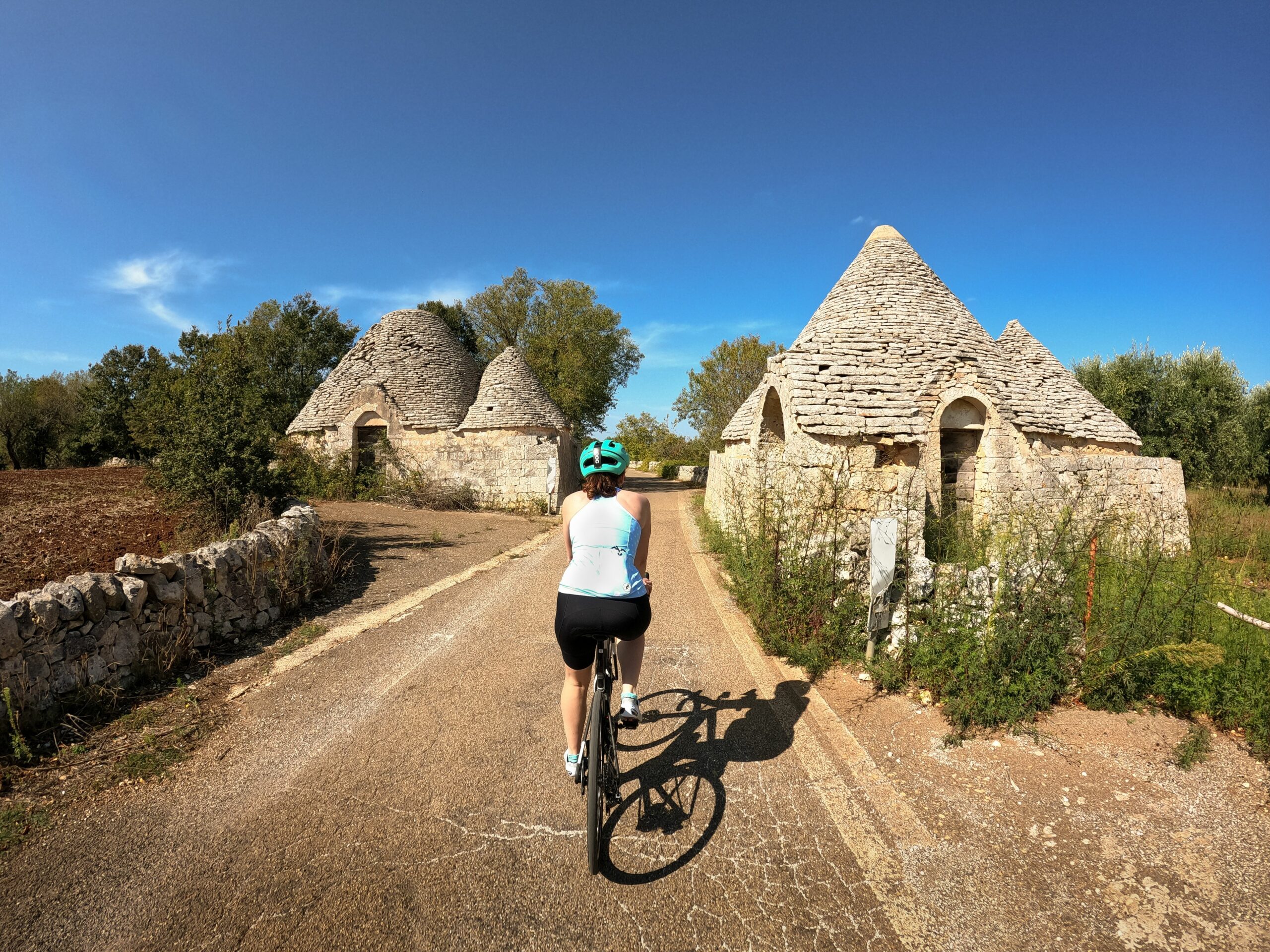
Puglia’s Valle d’Itria is often recognized for its trulli, but many visitors see the whitewashed villages from a car window and miss the lanes between them. By bike, the region reveals a gentle patchwork of vineyards, cherry orchards, olive groves, and tiny agricultural roads connecting Locorotondo, Cisternino, Martina Franca, and lesser-known hamlets.
There are few long climbs, which makes this one of Italy’s most welcoming regions for e-bike travelers, families with confident teens, and riders who prefer a moderate daily distance. The pleasure lies in the pauses: burrata from a local dairy, a glass of crisp white wine, or an unplanned stop when a village festival spills into the street. Summer is lively but hot; May, June, September, and October are particularly rewarding.
Gargano and the Foresta Umbra, Puglia
Farther north in Puglia, the Gargano Peninsula feels worlds away from the flat heel of the boot. Coastal roads curl above the Adriatic, while the Foresta Umbra brings cool, green shade and a surprising sense of wilderness. White villages such as Vieste and Peschici provide the coastal punctuation, but the interior is where the route becomes truly memorable.
Gargano is best for riders comfortable with sustained climbing and quick changes in weather. A day may begin in bright sun by the sea and finish under a forest canopy. Road bikes are excellent on the main paved routes; gravel bikes add options on selected rural tracks, provided conditions are dry and the route has been properly checked.
Cilento, Campania
South of the Amalfi Coast, Cilento offers the same southern Italian generosity with far less performance. Ride from the Greek temples of Paestum toward hill towns and the Tyrrhenian shore, where small harbors, buffalo mozzarella farms, and family-run trattorias shape the day as much as the elevation profile.
The inland roads can be steep and remote, so this is not the place to rely on a generic map route with no backup plan. It is, however, superb for riders who like a blend of archaeological sites, coastal scenery, and authentic village life. A supported or carefully arranged self-guided trip lets you enjoy the quiet without worrying about luggage transfers, water stops, or the right road at every fork.
How to choose the right lesser-known Italian ride
Start with the experience you want at the end of the day. If you imagine beach swims, easy pedaling, and a long dinner outdoors, Valle d’Itria or the Val di Noto coast will likely fit better than Ogliastra. If your ideal reward is an empty mountain descent followed by rustic mountain cooking, Sardinia’s east coast, Gargano, or Abruzzo may be the stronger choice.
Then be honest about support. Independent travelers can enjoy these regions deeply, but hidden routes often mean fewer bike shops, irregular opening hours, patchy phone signal, and roads that look very different on the ground than on an app. A locally designed self-guided itinerary gives you independence with the practical details already handled. Guided travel adds another layer: the stories, detours, and introductions that turn a beautiful ride into a memorable place.
At Mediterras, our local guides design routes with that balance in mind. We look beyond mileage to consider wind direction, road surfaces, lunch timing, hotel character, and the small producers worth meeting. The right itinerary leaves room for discovery without leaving the important things to chance.
Italy’s famous cycling roads deserve their reputation. But on a quiet lane in Sardinia, Sicily, Puglia, Campania, with a village bell marking the hour and no rush to be anywhere else, you may find the ride you remember most was never the one everyone else was taking.